iBET Presents Alicyclobacillus Research at IUMS 2026
Two Posters on Biopreservation and Genetic Tools for a Spoilage-Relevant Genus in Acidified Foods
iBET’s Microbiology & Molecular Biology area members took part in the 19th Congress of the International Union of Microbiological Societies (@IUMS), held in Lisbon from 4 to 6 November.
Under the theme “Beyond the Microscope: AI & Innovation in Microbiology”, the congress brought together scientists working on bacteriology, virology, and mycology, covering topics from microbial genetics, molecular and synthetic biology to applied microbiology in biotechnology, food, health, industry, and environmental sustainability.
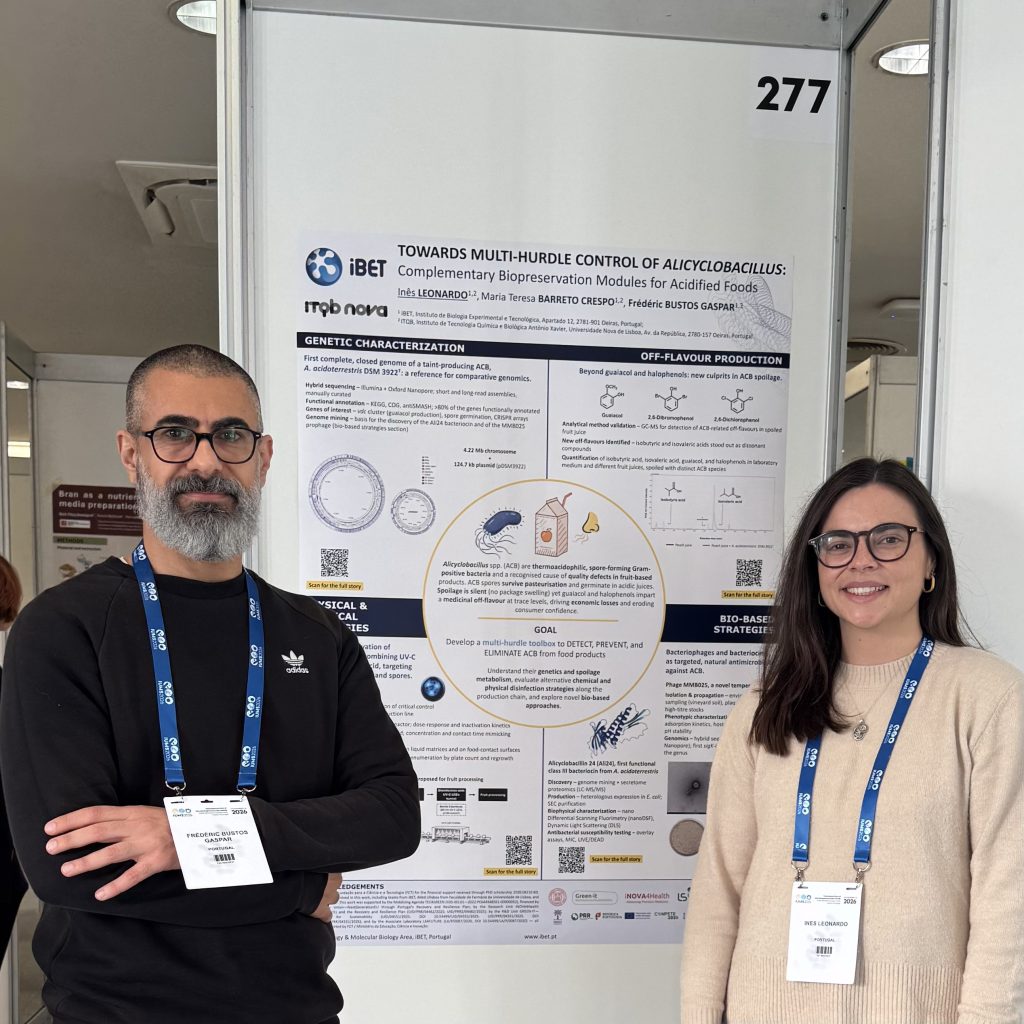
Frédéric Bustos Gaspar, senior scientist of Microbiology & Molecular Biology area, and Inês Leonardo, postdoctoral fellow from the same area, presented two posters on Alicyclobacillus, a spoilage-relevant genus in acidified foods. These thermoacidophilic, spore-forming bacteria can survive pasteurisation, germinate in acidic juices, and cause off-flavours at very low cell densities, mainly in fruit-based products.
The first poster, “Towards multi-hurdle control of Alicyclobacillus: complementary biopreservation modules for acidified foods”, presented a multi-hurdle toolbox to detect, prevent, and eliminate Alicyclobacillus in food products. It builds on the first complete, closed genome of a taint-producing strain, Alicyclobacillus acidoterrestris DSM 3922T, which also guided the discovery of the bio-based tools described below, and on the identification of new off-flavour compounds, isobutyric and isovaleric acids, beyond the known guaiacol and halophenols, using a validated GC-MS method. As spoilage is silent, with no package swelling, preventing these off-flavours depends on controlling the bacteria themselves. The poster therefore covered complementary control modules: UV-C LED disinfection of liquid matrices and food-contact surfaces, and bio-based strategies, namely the novel temperate phage MMB025, and alicyclobacillin 24 (Ali24), the first functional class III bacteriocin from A. acidoterrestris.
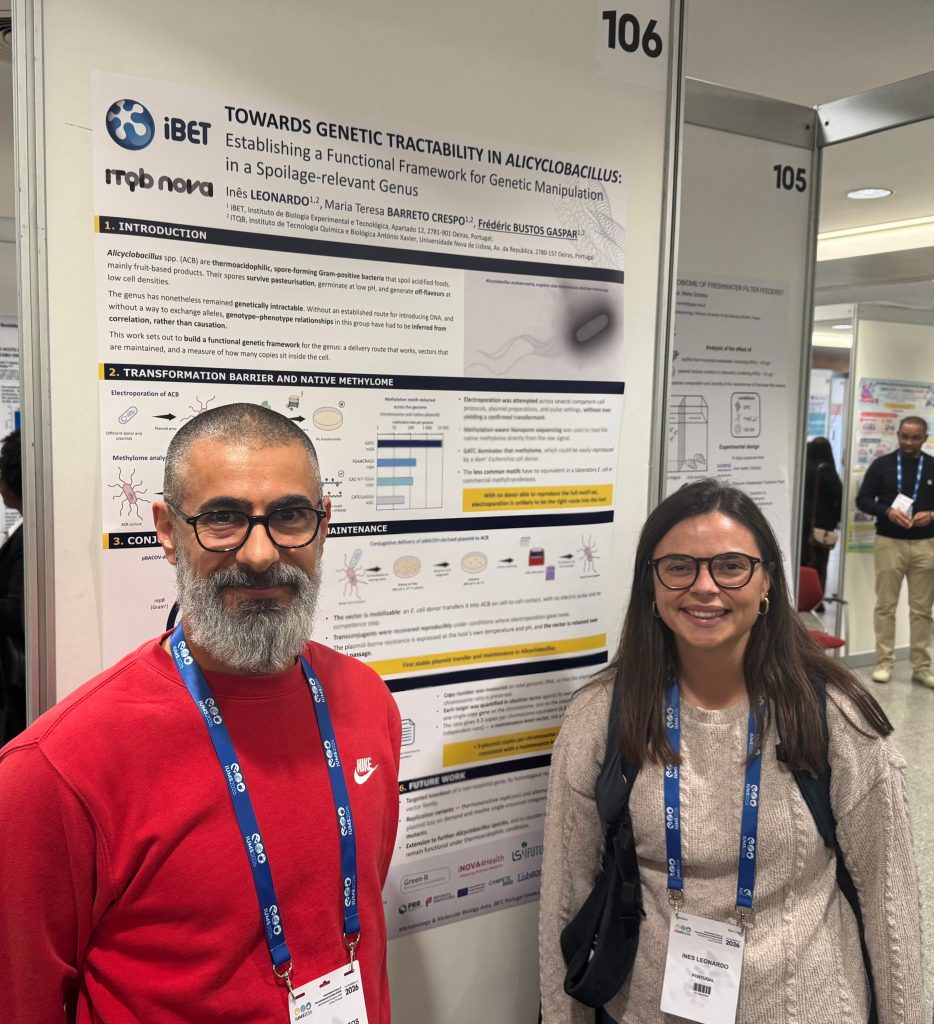
The second poster, “Towards genetic tractability in Alicyclobacillus: establishing a functional framework for genetic manipulation in a spoilage-relevant genus”, addressed a long-standing limitation: the genus has remained genetically intractable, so links between genotype and phenotype have been inferred from correlation rather than causation. After electroporation did not yield transformants, and methylome analysis pointed to the host’s native methylation as a likely barrier, the team showed that a pBACOV-derived plasmid can be transferred by conjugation from an Escherichia coli donor and is retained over serial passage, the first stable plasmid transfer and maintenance in Alicyclobacillus. Next steps include targeted gene knockouts and extension to other Alicyclobacillus species.
The congress was also an opportunity to connect with peers and to hear keynotes by Nobel laureates Drew Weissman (mRNA-LNP) and Emmanuelle Charpentier (CRISPR).