Downstream Process Development at esib 2026
Invited Lecture, Talks and Posters from iBET’s Downstream Process Development Lab in Graz
iBET’s Downstream Process Development Lab took part in the European Summit of Industrial Biotechnology (esib), held in Graz, Austria, from 10 to 13 November. This year, esib joined forces with MaPEB, the International Conference on Metabolic and Protein Engineering for Biosynthesis.
Esib is one of the biggest biotech conferences in Europe and serves as an international platform for industrial biotechnology, covering science, industrial needs, economic demands, funding resources and political aspirations. MaPEB focuses on the intersections of metabolic and protein engineering, and on the engineering and de novo design of complex biological systems.
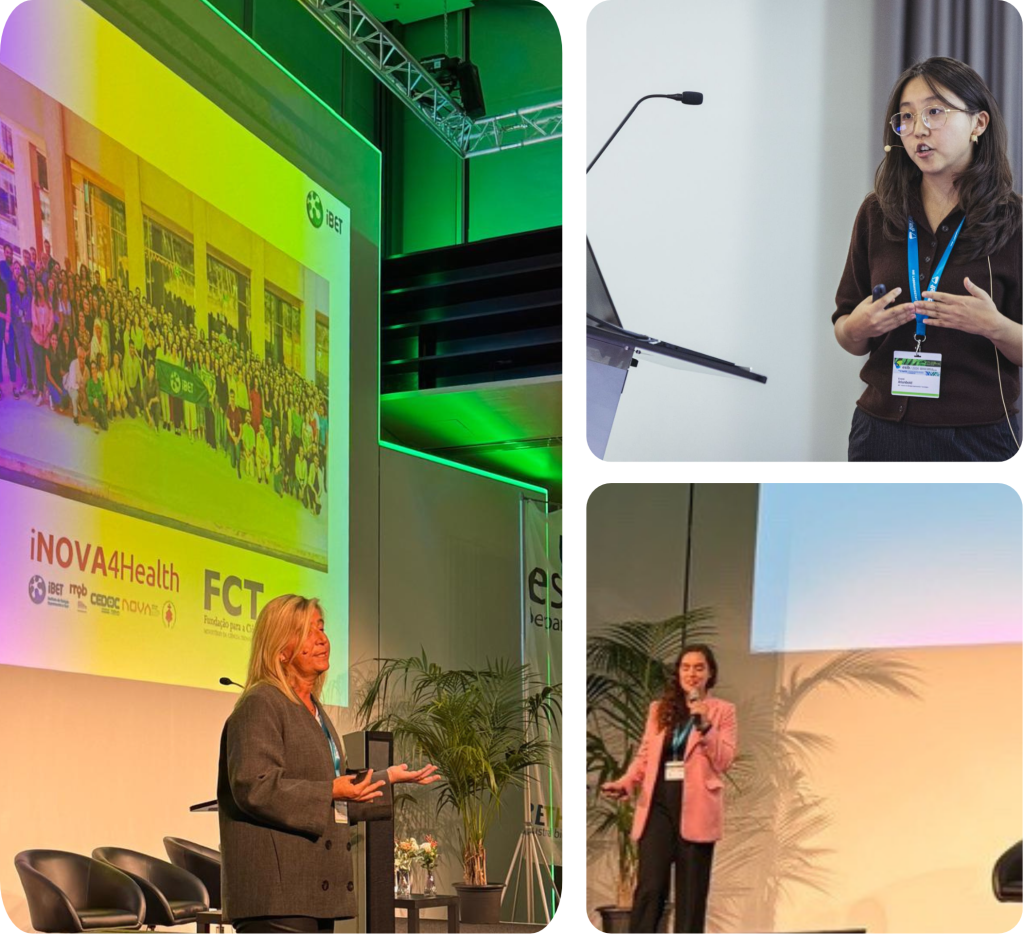
Cristina, Enerel and Carolina presenting at esib2026
Cristina Peixoto, Head of the lab, gave an invited lecture entitled “Smarter Processes: Integrated and continuous manufacturing for new therapeutic modalities” in the session “Intensified and continuous biomanufacturing”. The lecture gave an overview of integrated and continuous manufacturing approaches and then focused on iBET’s case studies in cell therapy, extracellular vesicles (EVs) and AAV.
Enerel Ariunbold and Carolina Jahn, PhD students at the lab, are part of CAARE (Characterization and Recovery of Bionanoparticles for Vaccine Delivery and Gene Therapy), an EU-funded doctoral network under the Marie Skłodowska-Curie programme, launched in October 2024. CAARE brings together academic and industry partners to train the next generation of researchers in vaccine and gene therapy manufacturing, integrating advanced analytical techniques, innovative process control and monitoring, and next-generation purification strategies for bionanoparticles.
Enerel Ariunbold presented a poster and gave a talk in the session dedicated to CAARE and presented a poster on her work on streamlining AAV8 purification with integrated cyclic capture-polishing. The work, developed in collaboration with PAK BioSolutions, combines AAVX affinity capture and anion-exchange membrane polishing in a repeated-cycling format, enriching full capsids from 34% to 79% in the final product pools, with an overall vector genome recovery of 44%.
Carolina Jahn gave a talk in the Science Flash session, and presented the poster “DNA and Beyond: What AAV Lysis Reveals About Chromatin-Associated Impurities”. AAV manufacturing requires cell lysis to release the intracellular particles, which also releases large amounts of host-cell DNA and chromatin-associated impurities. The study compared conventional and salt-active nucleases for removing these impurities in AAV2 lysates, assessing DNA and histone-associated impurity profiles under different process conditions. The results show that salt conditions influence chromatin structure and the performance of nuclease treatment, leading to distinct impurity profiles entering downstream purification. They highlight the importance of considering chromatin-associated impurities beyond residual DNA measurements.
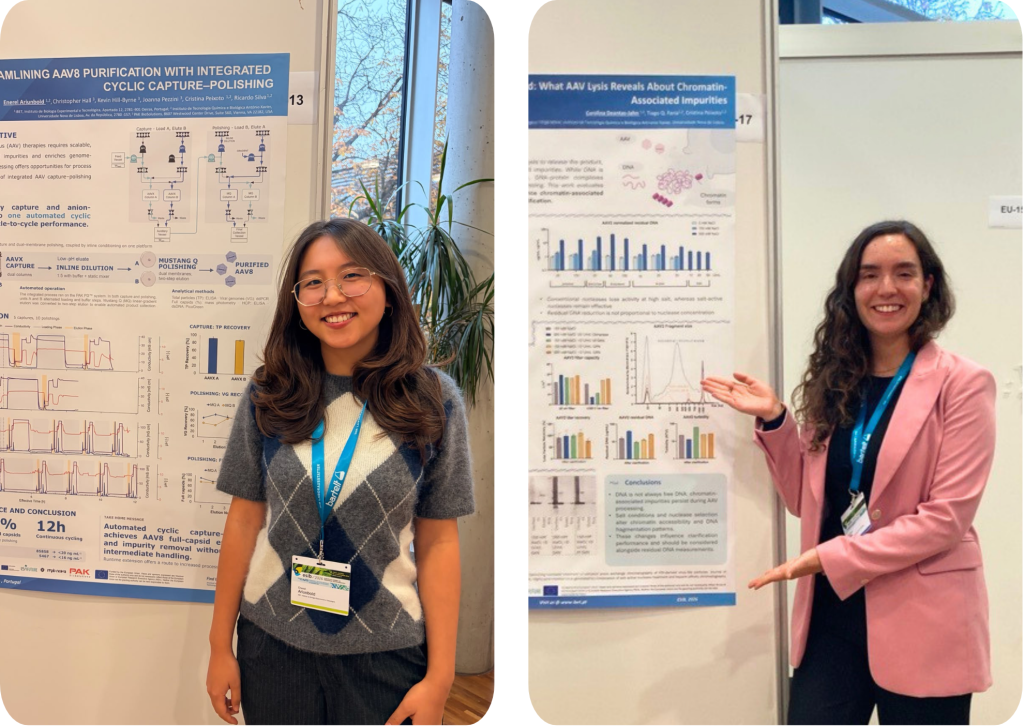
Enerel and Carolina also had poster presentations of their research work